INTRABRAIN
Nanoplatforms and Oncolytic viruses for novel cancer immunotherapy strategies of glioblastoma

Doctorate projects in Intrabrain
The INTRABRAIN doctoral network will address the major challenges of treating Glioblastoma Multiforme by overcoming immune evasion, the restrictive blood-brain barrier, and the limited effectiveness of conventional immunotherapy approaches through the development of innovative nanoparticle-based and oncolytic virus–enhanced vaccine strategies. The project will provide the 14 doctoral candidates with advanced interdisciplinary training at the interface of nanomedicine, virotherapy, and cancer immunotherapy, while fostering close collaboration with academic and industrial partners to develop both scientific expertise and strong translational and entrepreneurial skills.

PROJECT MISSION AND VISION

The project tackles critical unmet needs in Glioblastoma treatment, including poor drug delivery across the blood–brain barrier, tumour-induced immunosuppression, limited efficacy of current immunotherapies, and the lack of scalable, off-the-shelf therapeutic solutions capable of improving patient survival and clinical outcomes.
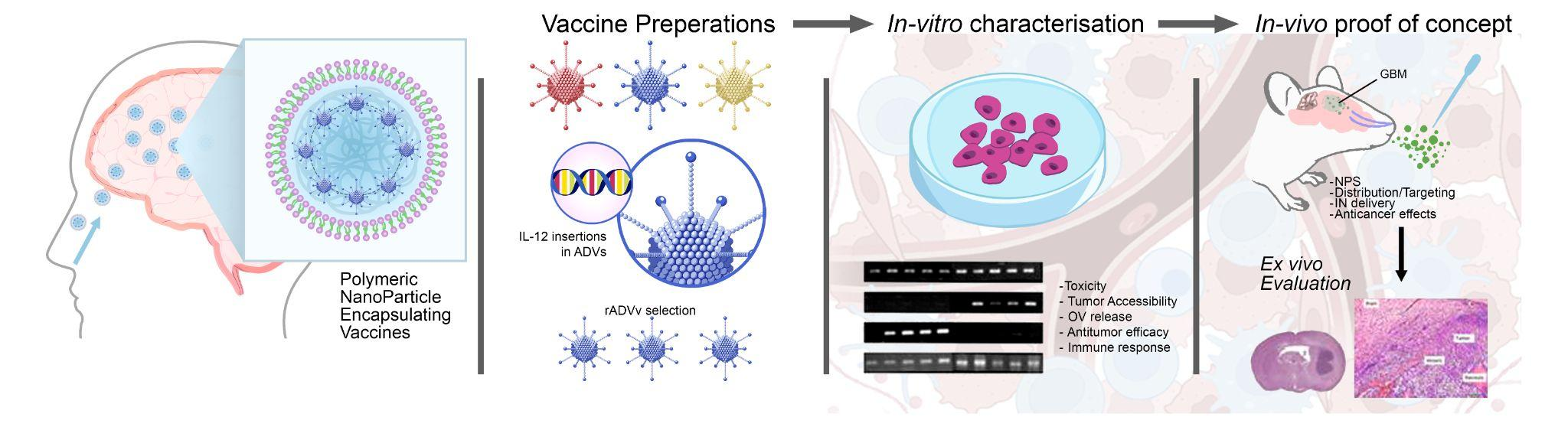
The project’s innovation lies in integrating advanced nanotechnology and virotherapy to overcome key limitations in current GBM treatments, by developing a multifunctional platform that combines polymeric nanoparticles and self-assembled nanoplatforms with IL-12–armed oncolytic viruses for protected, targeted delivery across the blood–brain barrier via the intranasal route.
The network brings together leading academic institutions and industry partners across disciplines, fostering collaboration in nanomedicine, virotherapy, and immunology. This integrated, transsectoral approach enhances knowledge exchange, accelerates innovation, ensures translational impact, and provides high-quality training, ultimately strengthening the project’s scientific excellence and real-world applicability.
SCientific work packages
WP1 – Generation of ADV variants
This work package focuses on the design, production, and validation of IL-12–armed recombinant adenoviruses. It includes the generation of different viral variants, followed by comprehensive in vitro and in vivo characterisation to assess their oncolytic activity, biodistribution, safety, and therapeutic potential in glioblastoma models.
WP2 – Biomaterials: Optimisation of the delivery vehicle
WP2 aims to develop and optimise advanced biomaterial-based delivery systems for oncolytic viruses, including polymeric nanoparticles, lipid vesicles, and hydrogels. The work centres on improving viral stability, targeting, and controlled release, while ensuring biocompatibility and efficient delivery—particularly via innovative routes such as intranasal administration.
WP3 – Functional analysis: Therapeutic efficacy & immune response
This work package evaluates the therapeutic performance of the developed platform by assessing anti-tumour efficacy, immune activation, and modulation of the tumour microenvironment. It includes in vitro and in vivo studies to investigate toxicity, stability, biodistribution, and the overall effectiveness of the combined nanoplatform and virotherapy approach.
WP4 – Training
WP4 is dedicated to implementing a comprehensive and interdisciplinary training programme for doctoral candidates, focusing on key topics such as nanomedicine, oncolytic virotherapy, cancer immunotherapy, biomaterials engineering, and advanced drug delivery to the brain. In addition, candidates will be trained in translational research, entrepreneurship, communication, and project management, ensuring strong scientific and transferable skills development within both academic and industrial environments.
WP5 – Outreach, dissemination & exploitation
WP5 implements a range of concrete actions, including the creation of a public project website and visual identity, preparation of press releases and audio-visual materials, and active dissemination through scientific publications, conferences, open days, and initiatives such as Pint of Science. It also involves social media engagement, development and continuous updating of a Data Management Plan, monitoring of open science practices, structured intellectual property management, and the preparation and refinement of dissemination and exploitation plans, including market analysis for future applications.
WP6 – Management & coordination
WP6 ensures the effective coordination and governance of the project, including administrative, financial, and scientific management. It involves monitoring progress, managing risks, facilitating communication among partners, and ensuring that all activities are aligned with project objectives and timelines.
WP7 – Ethics requirements
This work package guarantees that all research activities comply with ethical standards and regulatory requirements. It includes continuous monitoring of ethical aspects, implementation of necessary safeguards, and regular reporting to ensure responsible conduct throughout the project.